Monday, September 19, 2011

Book Review: "Feynman"
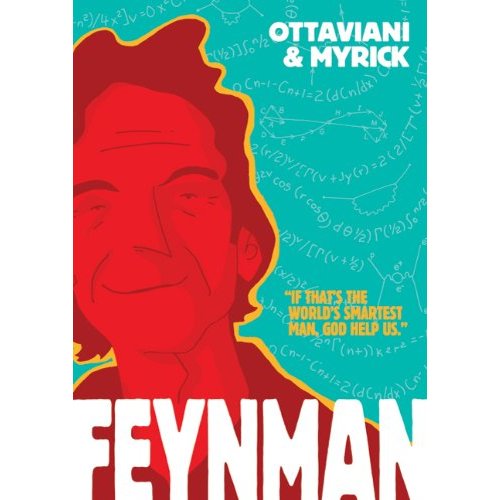
With his colorful personality and constant propensity to get into all kinds of adventures, Richard Feynman is probably the perfect scientific character to commit to comic book form, so in one way this graphic novel is long due. What is remarkable is how powerfully Jim Ottaviani and Leland Myrick harness this unique medium to accurately dramatize the life and qualities of this genius. Both authors are uniquely qualified for this endeavor, having already penned graphic portraits of Niels Bohr, Robert Oppenheimer and Leo Szilard.

Ottaviani and Myrick manage to capture the essential characteristics that made Feynman such a cherished teacher, scientist, friend, colleague, and public personality. Most importantly, the book succeeds in vividly bringing out Feynman's quintessential quality of almost obsessively staking out his own iconoclastic path both in science and in life. The biography is really a memoir akin to "Surely You're Joking Mr. Feynman" since it features Feynman's own account of his life, work and intellectual development. The great strength of the book is that it uses close-ups and color to highlight key words and moments from Feynman's life. While the biographical information in the book has been covered in other works and most notably in Feynman's own memoirs, the comic book form has a very different impact because of the combined literary-visual effect it has on the viewer.


For instance, in describing Feynman's time at Los Alamos, one can actually see people's bewildered faces as they struggled to comprehend both his genius in solving intractable physics problems and his wildly successful attempts at safe-breaking. There are evocative close-ups of Feynman's father teaching him to appreciate and truly understand nature during walks in the park, of Feynman encouraging his sister to learn science and his wonderful and tragic relationship with his first wife. Also included are Feynman's strip-club forays (during which he solved physics problems), his famous dunking of the Challenger space shuttle's O-rings into a glass of cold water to demonstrate their failure (again rendered much more dramatic by the graphic medium) and some fairly detailed albeit brief discussions of his pioneering work in quantum mechanics.


I was especially convinced of the power of the graphic form during the parts dealing with Feynman's lectures about scientific wonder and humility. As he paced the podium at Caltech and stressed the importance of holding oneself to an absolute standard of integrity, successive panels of the book zoomed in on his face. This device which is commonly employed in comic books imparts a heightened sense of importance to the words in a way that would not be evident on simply reading them. The other idea used in the comic medium is to intersperse the narrative with divergent panels; for instance, Feynman's eloquent description of science as a great game of chess intersects with snapshots of a chess game played by two people in a park where his father has taken him for a walk.

The minor gripe I have with this comic account is that the faces of different characters are sometimes not easily distinguishable. In addition the narrative would have had a bigger impact if the characters resembled their real life counterparts. But these minor points detract little from the volume's novelty. Ottaviani and Myrick have done a wonderful job in making a unique scientist and human being come alive in these pages. With the mountains of literature written about Feynman one would think that there's nothing new that could be said or done. But this "dramatic picture" of Richard Feynman, as his friend Freeman Dyson calls it, will occupy a proud place on the shelves of Feynman fans. Knowing his fondness for fun, Dick would undoubtedly have approved.

Labels:

Friday, March 18, 2011

"Quantum Man"


I still remember the day when, as a kid, I first came across the irrepressible Richard Feynman's memoirs "Surely you're joking Mr. Feynman". Within a few hours I was laughing so hard that tears were coming out of my eyes. Whether he was fixing radios 'by thinking', devising novel methods of cutting string beans in a restaurant or cracking the safes at Los Alamos, Feynman was unlike any scientist I had ever come across. Feynman died in 1988 and James Gleick's engaging and masterful biography of him appeared in 1993. Jagdish Mehra's dense, authoritative scientific biography came out in 1996. Since then there has been a kind of "Feynman industry" in the form of tapes, books, transcripts, interviews and YouTube video clips. While this has kept Feynman alive, it has also turned him into a kind of larger-than-life legend who is more famous in the public mind for his pranks and other exploits than for his science. Most laymen will tell you that Feynman was a brilliant scientist but would be hard-pressed to tell you what he was famous for. It's time that we were again reminded of what most contributed to Richard Feynman's greatness- his science. Lawrence Krauss's biography fulfills this role. You could think of Gleick's biography as a kind of Renaissance painting, an elaborate piece of work where he gets everything accurate down to the eyebrows of the men, women and Gods. Krauss's biography is more like the evocative impressionistic art of the French masters, more of a lucid sketch that brings out the essence of Feynman the scientist.

The biography is essentially aimed at explaining Feynman's scientific contributions, their relevance, importance and uniqueness. Thus Krauss wisely avoids pondering over oft-repeated details about Feynman's personal life. He compresses descriptions of Feynman's childhood, the tragic story of his first wife's death and their extremely touching relationship and his time at Los Alamos into brief paragraphs; if we want to learn more we can look up Gleick or Feynman's own memoirs. What concerns Krauss more than anything else is what made Feynman such a great scientist. And he delivers the goods by diving into the science right away and by explaining what made Feynman so different. Perhaps Feynman's most unique and towering ability was his compulsive need to do things from scratch, work out everything from first principles, understand it inside out and from as many different angles as possible. Krauss does a great job in bringing out this almost obsessive tendency to divine the truth from the source. It manifested itself at a very early age when Richard was cranking out original solutions to algebra and arithmetic problems in school. And it was paramount in his Nobel Prize winning work.

Krauss succinctly explains how this intense drive to look at things in new ways allowed Feynman to do novel work during his PhD with John Wheeler at Princeton in which he formulated theories that described antiparticles as particles traveling backwards in time. Later Feynman also applied the same approach in using a novel method based on the principle of least action to explain the dizzying mysteries of quantum electrodynamics. Krauss does an admirable job in explaining the physics behind these contributions in layman's terms. Feynman's "sum over histories" prescription involved taking into consideration all of the infinite paths that a particle can take when getting from the beginning to the end point. This was a bizarre and totally new way of looking at things, but then quantum mechanics is nothing if not bizarre. As Krauss describes, the moment of revelation for Feynman came in a meeting where, using his techniques and intellectual prowess, he could finish in a few hours a complicated calculation for mesons that had taken another researcher several months. Krauss also narrates how Feynman brought the same freewheeling, maverick approach to thinking about superfluidity, beta decay, the strong nuclear force, gravity and computing and the book contains the most complete popular scientific treatments of Feynman's thoughts about these important problems that I have seen. The approach did not always work (as it did not in case of superconductivity) but it encouraged other physicists to think in new ways. In fact as Krauss lucidly narrates, Feynman's great influence on physics was not just through the direct impact of his ideas but also through the impact of his unconventional thinking which inspired students and other scientists to think outside the box.

As scientifically brilliant as Feynman was, Krauss also does not gloss over his professional and personal flaws and this biography is not a hagiography. Professionally, Feynman's independent spirit meant that he often would not read the literature and would stay away from mainstream interests which his colleagues were pursuing; while this greatly helped him, on more than one occasion it led to him being scooped. At the same time Feynman also did not care about priority and was generous in sharing credit. As for mentoring, while Feynman was a legendary teacher by way of example, unlike his own advisor John Wheeler he left few bonafide graduate students because of his compulsive tendency to solve problems himself. On a personal basis, probably the most shocking description concerns Feynman's womanizing. It's hard to say how much of it is true, but Krauss describes Feynman's affairs with colleagues' wives, his elaborate methods to seduce women in bars and the personal and emotional entanglements his womanizing caused. At least one fact is jarring; apparently when he was a young professor at Cornell, the boyish-looking Feynman used to pretend to be a graduate student so he could date undergraduates. This kind of behavior would almost certainly lead to strict disciplinary action in a modern university, if not something more drastic. In his early days Feynman was also known for not suffering fools gladly, although he mellowed as he grew older. Later on Krauss details Feynman's more publicly known activities, including his bongo playing, nude painting and his famous demonstration of the failure of the O-rings in the Challenger space shuttle disaster. Feynman's absolute insistence on honesty and truth in science and on reporting the negative results along with the positive ones also comes across, and should be a model for modern scientists. The biography does a good job of demonstrating that in science, true success needs fearlessness, determination and an unwavering belief in your ideas.

Ultimately, it's not Feynman's bongos, nude art and relentless clowning that make him a great man. However, since his death, he has often been perceived that way by the public largely due to the industry that has grown up around him. But Richard Feynman was defined first and foremost by his science and his striking intellectual originality that allowed him to look at the physical world in wholly unanticipated new ways. Krauss's biography performs a timely and valuable service in reminding us why, when we talk about Feynman, we should first talk about his physics.

Labels: , ,

Wednesday, September 09, 2009

The beat of a different drum

Jagdish Mehra's biography of Feynman, "The Beat of a Different Drum" is one of the more notable biographies of the great man around, with James Gleick's "Genius" being better known to the general public. There is also an excellent biography of Feynman by John and Mary Gribbin. But there seems to be an acrimonious debate in the comments sections of the Amazon reviews of Mehra's book. Essentially they boil down to Neil Mehra, Jagdish Mehra's son, vehemently lambasting anyone who thinks it's not a good biography and who instead happens to praise Gleick's biography.

Mehra cannot stop praising his father enough and constantly noting that he personally knew the greatest physicists of the century including Feynman himself for thirty years. Apparently Feynman used to hold Mehra in very high regard. To be honest, Mehra junior's constant and extreme praise for his father and condescension towards others get a little tiresome after a while, but I have to admit that I remember being fascinated and very impressed with this book when I discovered it in the library of IISc. on a lazy afternoon in the summer of 2002. There are some parts in the book which are full of equations and would be comprehensible only to a theoretical physicist; this thus seems to be the only scientific as well as personal biography of Feynman around as such. Interestingly Silvan Schweber (author of a scientific biography of the men who developed quantum electrodynamics) gave this book a scathing review in Physics Today and berated Mehra for apparently neglecting Gleick's book, and Mehra responded with a clearly angry rejoinder. Mehra noted that the great Hans Bethe (who was one of Feynman's close mentors) had asked Mehra to help Gleick with his Feynman biography.

I of course like Gleick's biography a lot but Mehra junior, notwithstanding his rants, has a point; unlike Mehra who definitely knew Feynman well, Gleick hadn't met the man at all, and I would think this would definitely impact his portrayal of Feynman and make Mehra's portrayal a better one in some respects. Unlike Gleick, Mehra also certainly knew enough physics to actually understand Feynman's work and set it in its correct scientific context. Mehra was also uniquely familiar with the history of physics (and much older than Gleick), edited or wrote several biographies of physicists, and co-authored a magisterial and definitive six-volume conceptual history of quantum mechanics. From a scientific standpoint Mehra was undoubtedly better equipped to understand Feynman's scientific development.

However, a scientific biography is also more than laying out just the science. From what I remember, Gleick was simply the better writer, had a better style and a novelist's eye for detail; consider his fascinating and sparkling narrative in "Chaos". This of course does not make Mehra's biography any less accurate or preempt his understanding of physics and its history but it makes Gleick's book more attractive and accessible to laymen. In the end Mehra was the better physicist and Gleick was the better writer. In any case, this bitter debate has again fueled my desire to read the volume and I have ordered a used copy from Amazon and am eagerly awaiting it.

Is personal acquaintance an important prerequisite for writing a good biography? I think that in general it is, but there also seem to be great counterexamples; Richard Rhodes's famous book for instance does a great job in describing several scientists like Oppenheimer and Bohr who the author had not met. Books like Gleick and Rhodes should encourage young writers to write about historial subjects who they may not have been personally acquainted with.

Labels: , , ,